Featured project
DevData Generator
Browser-based fake data generator that creates one reusable dataset and exposes the same result through table, JSON, CSV and SQL outputs.
Runs entirely in the browser; no backend or database is required.
Overview
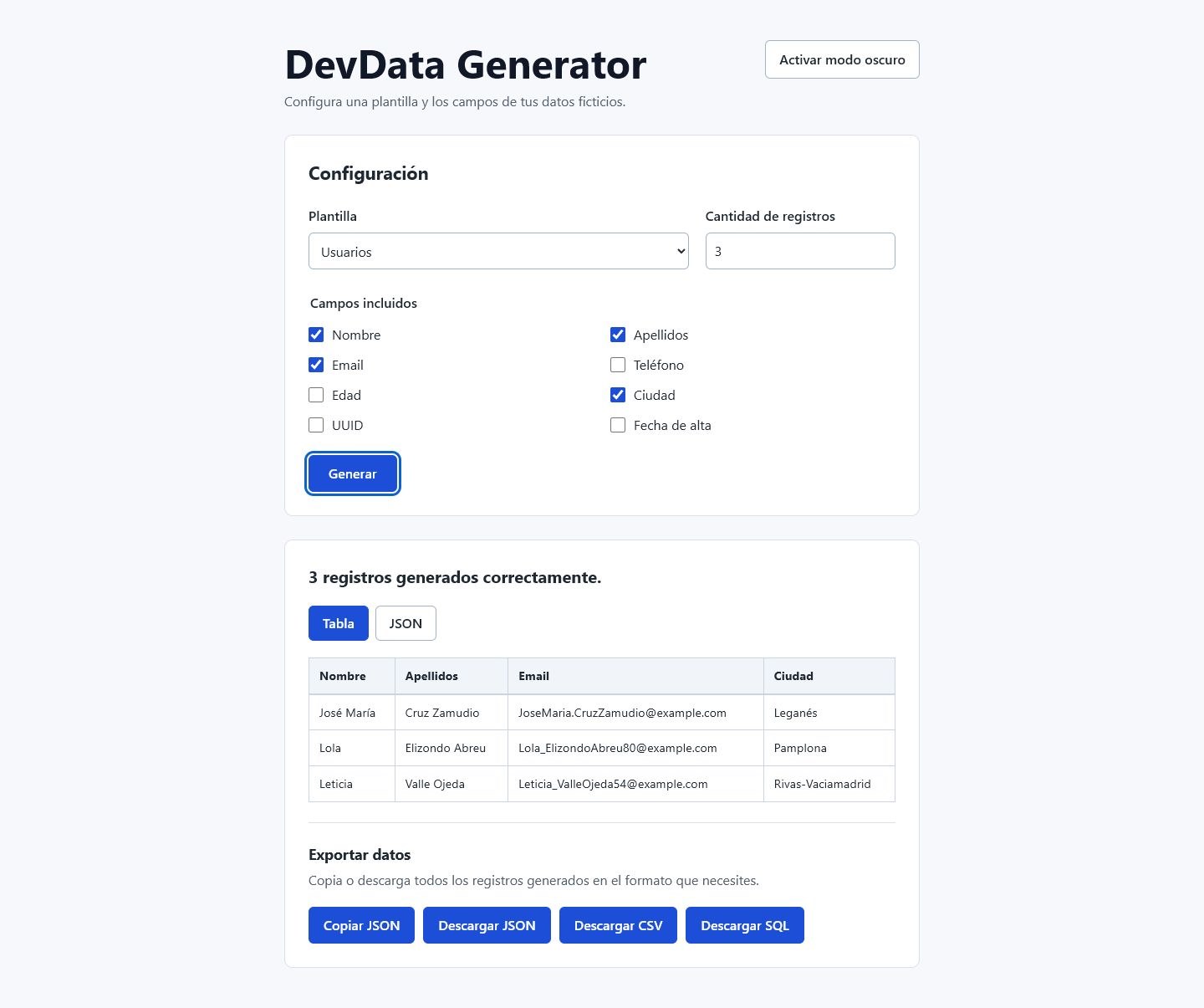
DevData Generator is a browser-based tool for configuring realistic fake datasets and reusing one generated result across table, JSON, CSV and SQL outputs.
Product
How the product works
A compact view of configuring, generating, inspecting and reusing one dataset.

Configure dataset
Choose template, fields and number of records.
Generate
Create the configured fake records.
Generated dataset
The records produced from the current configuration.
Inspect result
View the same records as a table or JSON.
Reuse result
Copy or download the generated records as JSON, CSV or SQL.
System
How the same flow is structured
Open the product flow to inspect the state, generation boundary and downstream consumers beneath it.
Configure dataset
Configuration state
Holds selected template, fields and record quantity.
- Relationships
Flows to
- Validation
Invalidates
- generatedData
- Implementation notes
- App coordinates the shared workflow state.
- No Redux or other global state library is used.
Generate
Validation
Checks quantity and whether at least one field is selected.
- Relationships
Receives from
- Configuration state
Flows to
- generateData()
generateData()
Creates the configured records using the generator associated with the selected template.
- Relationships
Receives from
- Validation
Depends on
- Faker
Produces
- generatedData
Faker
Provides fake values used by generation.
- Relationships
Used by
- generateData()
Sourcesrc/utils/generateData.jsGeneration stays behind one utility boundaryView evidence
import { fakerES as faker } from '@faker-js/faker'export function generateData({
templateId,
selectedFields,
numberRecords,
}) {
const generateRecord = recordGenerators[templateId]
return Array.from({ length: numberRecords }, (_, index) =>
generateRecord(selectedFields, index),
)
}The utility imports Faker, selects the configured record generator and creates the requested records through generateData().
Generated dataset
generatedData
Stores the current generated records as the shared result of one generation.
- Relationships
Produced by
- generateData()
Consumed by
- Preview
- Export
Invalidated by
- Configuration state
- When
- Template changes
- Selected fields change
- Quantity changes
- Why it matters
- All visible and downloadable outputs represent the same generation.
Sourcesrc/App.jsxConfiguration changes clear the shared resultView evidence
setSelectedTemplate(templateId)
setSelectedFields(newTemplate.fields.map((field) => field.id))
setGeneratedData([])const handleFieldChange = (fieldId) => {
setSelectedFields((currentFields) =>
currentFields.includes(fieldId)
? currentFields.filter((id) => id !== fieldId)
: [...currentFields, fieldId],
)
setGeneratedData([])
}const handleNumberRecordsChange = (value) => {
setNumberRecords(value)
setGeneratedData([])
}Template, selected-field and quantity handlers each clear generatedData after changing configuration.
Inspect result
Preview
Presents generatedData as Table or formatted JSON.
- Relationships
Receives from
- generatedData
- Implementation notes
- Table preview and JSON preview consume the same generatedData.
Reuse result
Export
Routes generatedData into copy and download transformations.
- Relationships
Receives from
- generatedData
Flows to
- Output serializers
Output serializers
Transforms generatedData into JSON, CSV or SQL output.
- Relationships
Receives from
- Export
Flows to
- Browser APIs
- Implementation notes
- JSON preview, copy and download reuse the same JSON serializer.
- CSV and SQL use dedicated serializers.
- SQL output is downloaded as INSERT statements; it is not executed.
- The app has no database.
Browser APIs
Handles clipboard and file downloads in the browser.
- Relationships
Receives from
- Output serializers
- Implementation notes
- File download uses browser-native APIs.
Illustrative Users recordOne result, three serialized representationsIllustrative data, not a recorded execution
JSON
[
{
"nombre": "Ana Torres",
"email": "[email protected]"
}
]CSV
"nombre";"email"
"Ana Torres";"[email protected]"SQL
INSERT INTO usuarios (nombre, email) VALUES ('Ana Torres', '[email protected]');The same illustrative record is shown as JSON, semicolon-delimited CSV and a downloadable SQL INSERT statement.
System flow
- Configuration stateValidation
- ValidationgenerateData()
- FakergenerateData()
- generateData()generatedData
- generatedDataPreview
- generatedDataExport
- ExportOutput serializers
- Output serializersBrowser APIs
Separate invalidation rule
Configuration state — Invalidates when configuration changes — generatedData
Related technical decisions
Open either verified decision when its context is useful.
Decision 01Why one shared generated result?Preview and exports reuse one generated dataset.
- Context
- Preview and exports need to represent the same generation.
- Decision
- Generate once, store the result in generatedData, and let downstream consumers reuse it.
- Consequence
- Preview and export paths do not regenerate Faker data.
Decision 02Why clear results after configuration changes?A changed configuration invalidates the previously generated records.
- Context
- Old generated data no longer corresponds to a changed template, field or quantity configuration.
- Decision
- Clear generatedData when those inputs change.
- Consequence
- The UI returns to the empty, result-needed state until the user generates again.
Product
How the product works
A compact view of configuring, generating, inspecting and reusing one dataset.
Illustrative configurationUsers · 3 records · 4 fields

Configure dataset
Choose template, fields and number of records.
Generate
Create the configured fake records.
Generated dataset
The records produced from the current configuration.
Inspect result
View the same records as a table or JSON.
Reuse result
Copy or download the generated records as JSON, CSV or SQL.
Related technical decisions
Open either verified decision when its context is useful.
Decision 01Why one shared generated result?Preview and exports reuse one generated dataset.
- Context
- Preview and exports need to represent the same generation.
- Decision
- Generate once, store the result in generatedData, and let downstream consumers reuse it.
- Consequence
- Preview and export paths do not regenerate Faker data.
Decision 02Why clear results after configuration changes?A changed configuration invalidates the previously generated records.
- Context
- Old generated data no longer corresponds to a changed template, field or quantity configuration.
- Decision
- Clear generatedData when those inputs change.
- Consequence
- The UI returns to the empty, result-needed state until the user generates again.